Private AI. Owned clean energy. Room to grow at Muxaro.Discuss your allocation

Muxaro campus · Bivona, Sicily

One location.
A bigger ambition.

The first planned deployment brings 14 Vera Rubin NVL72 racks and 1,008 Rubin GPUs to Bivona. Further phases will grow alongside additional energy and infrastructure capacity at the campus.

Phase 01 / Vera Rubin

One campus.
Room to grow.

Our initial deployment is planned around 14 Vera Rubin NVL72 compute racks. Further phases will be developed alongside additional energy and infrastructure capacity.

14planned customer compute racks in the first deployment
1,008Rubin GPUs, with service spares specified separately

Future capacity, configuration and timing depend on final engineering, energy availability, permitting and commissioning. No fixed expansion multiple is implied.

Energy and compute, considered together

Rooted in place.
Built for the long term.

SicurAI aims to supply a significant share of annual campus energy from owned solar generation behind the meter. Planned storage will support renewable integration and resilience.

The annual renewable contribution will be validated for the Vera Rubin deployment, including cooling and campus systems. Grid capacity, solar production and battery autonomy are assessed separately.

RENEWABLE INTEGRATION

Generation close to demand.

Plan the relationship between compute, local generation and the grid as one system.

MODULAR DEVELOPMENT

A deliberate deployment path.

Coordinate facilities, compute delivery and commissioning around the agreed capacity requirement.

AGRICULTURAL HEAT REUSE

Connect compute with cultivation.

Plan a separate heat-recovery interface for hydroponic greenhouses and agricultural drying.

Our community commitment

Energy infrastructure / November 2026 planning basis

Power for the first deployment.

Coordinate the grid connection, on-site generation and planned reserves as one electrical design.

Grid capacity4.17 MW combined withdrawal capacity identified for the first phase, including 300 kW at the neighbouring plant. Grid upgrade works and integration of both supplies are part of site readiness.
Facility loadApproximately 4.1 MW planning load for the 14 active compute racks and auxiliary infrastructure. Final design will reconcile powered spares, operating margin and the complete equipment load.
Solar generationExisting local generation forms the renewable foundation. Annual energy contribution depends on production, the revised plant layout and the campus load profile.
Planned resilienceBESS design target: five hours of operation at approximately 4.1 MW. Battery power, usable energy and islanding capability require final engineering. Diesel generation is also planned; its delivery and commissioning will be tracked separately.
Supply arrangementThe design currently relies on a single grid line with planned local reserves. It is not presented as two independent utility feeds or a completed 2N system.

Planning basis, not an assertion that all infrastructure is installed or commissioned. Final service commitments follow engineering, delivery and acceptance.

Community & agriculture

Compute here.
Grow here.

Our commitment is to make Muxaro part of Bivona’s productive future. Alongside AI capacity, we are developing a route to put recovered heat to work for local agriculture.

Heat reuse is part of our campus development plan. Hydroponic greenhouses and agricultural drying are two planned applications, connecting digital infrastructure with crops, skills and local enterprise.

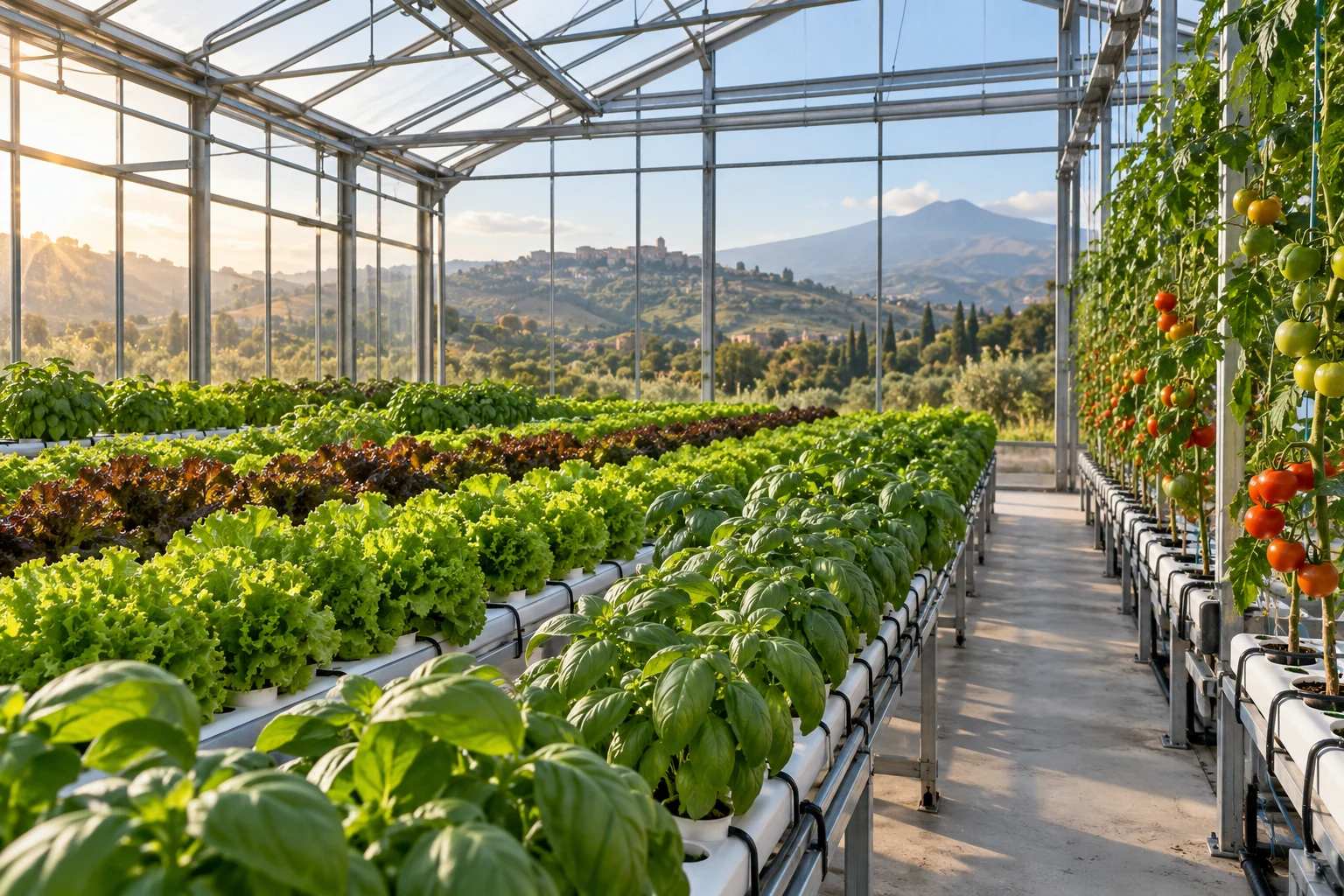
Concept visualization of a hydroponic greenhouse with leafy crops and tomatoes in a Sicilian landscape

A second use for the heat AI creates

One source of heat.
Two ways to create value.

01 / Hydroponic greenhouses

Grow more value.

We plan to use recovered heat to support greenhouse and root-zone heating when crops need it. Recirculating hydroponic systems would pair controlled growing conditions with careful water and nutrient management.

The focus is value-added produce: specialty herbs, leafy greens and selected fruiting crops, with crop choices shaped by agronomic expertise and market demand.

Specialty herbsLeafy greensSelected fruiting crops

02 / Agricultural drying

Give the harvest
a longer future.

Recovered heat could also support controlled drying: turning apricots into dried fruit, plums into prunes, and tomatoes into ingredients with a longer shelf life.

Our aim is to help local producers retain more value from their harvest, reduce avoidable losses and develop products that can reach customers beyond the fresh-produce season.

Dried apricotsPrunesDried tomatoes

The planned connection

Useful heat.
A separate agricultural system.

  1. RecoverCapture available heat from the liquid-cooling system.
  2. TransferPass heat through exchangers into a separate agricultural circuit.
  3. Put it to workMatch temperature and timing to the greenhouse or dryer, using heat pumps where needed.

Heat is transferred between systems; server coolant stays separate from irrigation water and food. Final facilities, crops and heat capacity will be defined with agricultural partners, engineering and seasonal demand.

Our commitment to Bivona

Build with the community.
Keep more value here.

A campus should contribute to the place that hosts it. We want Muxaro to connect new technology with the knowledge, produce and enterprise already rooted in this part of Sicily.

Work with local growers.

Develop the agricultural applications with growers, cooperatives and specialist operators, around real crops and routes to market.

Create opportunities for local skills.

Look for opportunities in cultivation, processing, maintenance and technical training as the agricultural programme develops.

Keep more value close to the harvest.

Bring growing and processing opportunities into the local economy, with products shaped by quality and demand.

Are you a grower, cooperative, agricultural operator or local organisation?
Let’s explore what we can build together.

Talk about local collaboration

Delivery path · reviewed 1 November 2026

Follow the path to service.

Target customer acceptance: approximately seven months from order, with a ±4-week planning window, subject to final configuration, supplier confirmation, site readiness and commissioning. The stages below define the path to service.

Current planning basis

Configuration and customer scope

Define the compute, facilities and operating requirements. Confirm the final technical and commercial scope.

Planned milestone

Procurement and delivery schedule

Confirm supplier commitments, the schedule starting point and the equipment delivery sequence.

Planned milestone

Site readiness and cluster deployment

SicurAI coordinates campus readiness. Installation, integration and supplier responsibilities will be aligned with the final Vera Rubin configuration and agreed delivery programme.

Planned milestone

Commissioning and acceptance

Complete agreed tests and operational handover before customer service begins.

Target customer acceptance

~7 months from order · ±4 weeks

Subject to final configuration, supplier confirmation, site readiness and commissioning. The contractual schedule and allocation are agreed with each customer.

Detailed project evidence and the customer-relevant delivery package are available through the technical diligence process.

Meet the project behind the capacity.

Request a technical discussion or enquire about a campus visit with the SicurAI team.

Discuss capacity